

“You must pay taxes. But there’s no law that says you have to leave a tip.”
– Anonymous
If you enjoy this newsletter, please share it!
In this issue
- Key Market Takeaways (Q4 2025 & full year 2025)
- My Take
- A New Investment Idea – Direct Indexing
- Case Study: Reducing Taxes on Large Capital Gains
- Q4’s webinar: Managing your RSUs: How to create a personalized plan
Market Snapshot
| Index | Q4 2025 | Full Year 2025 |
|---|---|---|
| S&P 500 | 2.7% | 17.9% |
| MSCI ACWI ex-US | 5.1% | 32.4% |
| Bloomberg US Aggregate Bond | 1.1% | 7.3% |
Key trends in 2025
- While the S&P 500 index grew for the 3rd year in a row (17.9%), stocks outside the US grew at almost 2x that rate (32.4%), driven by US dollar depreciation, relatively lower valuations and strong profit growth
- Technology led early, but gains broadened into healthcare, industrials, and value stocks late in the year
- Gold hit all-time highs in 2025 (up 64%), driven by concerns over currency debasement
- Bonds had their best year since 2021, as the Fed decreased interest rates, prioritizing sluggish jobs growth over fighting inflation
(Source: Morningstar, Bloomberg, FactSet)
My Take
Markets performed well across asset classes in 2025. While financial headlines often focus on whether a bull market is “about to end,” long-term investors are typically better served by focusing on diversification, risk management, and alignment with their personal financial goals rather than attempting to time short-term market movements
A portfolio designed to adapt to changing market conditions while remaining aligned with your long-term plan is generally more resilient than one based on predictions or headlines.
Articles that highlight risks and uncertainty are easy to find, and I won’t address them here. What is harder to find is positive information that supports a more balanced view, so I will offer a few here:
- Forecasts for AI spending continue to be robust
- Stock market growth in Q4 has become broader, both globally and across industries
- While US equity markets are highly-valued by historical standards, many segments of the global equity markets are more modestly priced, and they have rallied in 2025 and continue to show strength.
Strategy Spotlight: Direct Indexing
For investors anticipating a significant taxable event (such as the sale of stock, real estate, or a business), direct indexing is one way to manage both market exposure and taxes.
Unlike ETFs or mutual funds, direct indexing holds individual stocks designed to track an index. This allows:
• Customization (e.g., excluding companies or sectors)
• Tax-loss harvesting, where individual securities that decline in value may be sold to realize capital losses
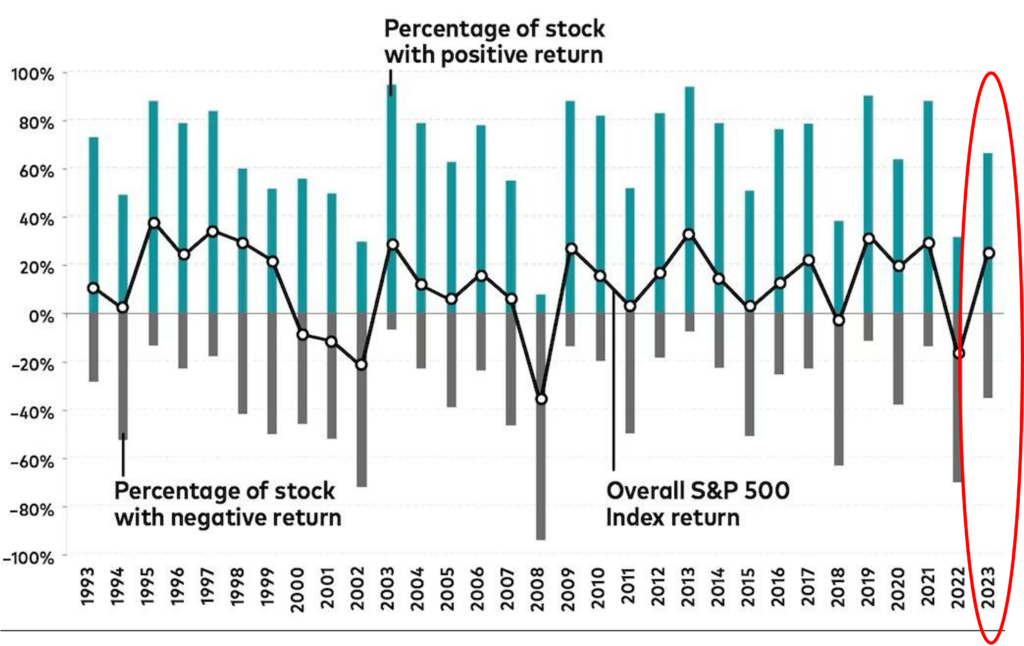
When you own an ETF or mutual fund, you get a net gain or loss for the year, but that return is calculated based on the weighted average gains and losses of all the securities in the investment – it is a bundled, or a “net” gain or loss. But in any one year there are securities in the investment that go up in value and down in value.
The following table shows that in any year – whether the market return (black line) is positive or negative, there are stocks that decrease in value (gray bar). These stocks are the ones that are sold, losses are booked and the money is reinvested. For example, in 2023, when the S&P 500 was up 26%, approximately 40% of the stocks in the index lost value.
S&P 500 Total Returns and Stocks Incr/Decr in Value, (1993-2023)
(Source: FactSet)
Direct indexing requires ongoing management and typically has higher costs and minimums than ETFs, but technology has reduced both over time.
Case Study: Reducing Taxes on Large Capital Gains
“Russell” – a physician – decided to sell his home in San Francisco and relocate to Mexico. When he came to me, his goal was to sell in Q4 of 2025. The sale of his house was going to create a $2.25M capital gain.
Rather than close on the sale in 2025, I encouraged him to have the sale close in January 2026. Why? Two reasons:
- The capital gain would be incurred in 2026, giving him ~15 months before payment was necessary (not 4 months if the house closed in 2025)
- The home sale proceeds could be invested using direct indexing, which would have 12 months to create paper losses that would offset the capital gain from selling the house
Benefits –
- Delay taxes due for a year and reduce overall taxes
- Build a diversified portfolio that will grow over time and could grow during the year before taxes are due
Create the potential for ongoing losses that can be saved and used to offset gains to reduce taxes in the future
RSU Planning Webinar
On December 11th, 2025, I held a webinar to help holders of RSUs answer 3 questions:
- Why do you need an RSU plan?
- What three questions should you ask yourself about your company stock?
- What process should you go through to create your plan?
I walk through a methodology for plan creation that includes a tool I have developed to help clients model the probabilities of different strategies and financial outcomes.
You can watch the 28-minute session (or short clips) at:
https://www.youtube.com/@MichaelBerginesPersonalCFO
Carefully timed conversions during lower income and/or early retirement years can lead to tax benefits later in retirement. My client’s 401K doesn’t qualify for a Mega Back-Door Roth, but we will look at a Roth conversion once his income drops after he leaves work.
Reader Survey: What Should I Cover Next?
Email mike@prosperowealth.com and let me know what topics matter most:
Markets • Investing • Taxes • Retirement • Concentrated Stock • Planning
— Mike
Important Disclaimers:
Prospero Wealth, LLC is an Investment Adviser registered with the SEC, principally located in the state of Washington. All views, expressions, and opinions included in this communication are subject to change.
The information provided in this newsletter is for general informational and educational purposes only and does not constitute investment, financial, legal, or tax advice.
Every individual’s financial situation is unique, and you should consult with a qualified financial professional before making any investment decisions. All investments involve risk, including the possible loss of principal.