

Stocks AND Interest Rates are up? What is going on?
“The only function of economic forecasting is to make astrology look respectable.” — John Kenneth Galbraith (famous economist)
If you enjoy this newsletter, please share it!
When the economy is providing conflicting signals, it is easy to think that you need to “have a view” and make a prediction to invest intelligently. That is where people get into trouble. The fact is, no one can predict what will happen with the economy
We all want to limit uncertainty in life and investing, but we also love the idea of “guessing right” on a forecast (or a stock) and reaping a windfall. But data shows us that these strategies don’t work, even when attempted by experienced professionals. The secret is to build a portfolio that will be successful in the long run, assuming uncertainty is a feature, not a bug.
In this issue:
- Key Market Takeaways (Q3)…My Take and Your Plan
- New Ideas/Products – “Sell” your investment property to an UPREIT – why pay capital gains tax upfront?
- Case Study: Using your company benefits to defer income taxes, diversify your investments and grow investments tax free
- Question from the Audience: Why is the value of my bond fund going down?
Key Takeaways – Q3 2026
Markets and Commodities
| Security/Index | Q3 2026 | 2026 YTD (9/30/26) |
| Nasdaq stocks – QQQ | 0.6% | 20.8% |
| S&P 500 stocks – SPY | 2.4% | 12.7% |
| Emerging Markets stocks – EEM | – 2.4% | 22.7% |
| Global (ex-US) stocks – ACWX | -0.6% | 13.9% |
| Commodities – DBC | 21.2% | 44.5% |
| Oil Futures – USO | 36.8% | 120.6% |
| US Aggregate Bonds – AGG | -3.5% | -2.8% |
Source: Schwab, Finance Charts
Inflation
The Consumer Price Index increased 0.4% on a seasonally adjusted basis in August, after rising 0.1% in July. Inflation was 3.4% before seasonal adjustments over the last 12 months.
Source: Bureau of Labor Statistics
Interest Rates-10-year Treasury Yields and average 30-year fixed mortgages
Interest rates have risen sharply this quarter –
- 10-year Treasury Yield (Oct 6) – 5.27% (4.53% three months ago)
- Average 30-year fixed mortgage rate (week ending Oct 1) – 7.28% (6.43% three months ago)
Source: Freddiemac.com, US Dept of Treasury
My Take – and Your Portfolio
It is rare to see the S&P rise by almost 13% through the first nine months of the year, when the 10-year Treasury note yield has increased 1% during the same period. Material increases in interest rates and bond yields often lead to lower stock prices – higher interest rates can “put the brakes” on economic growth and provide better relative returns for bonds than stocks.
So why are stocks doing well despite the bond market? It’s surprising, but quite simple: corporate earnings are increasing faster than rising interest rates can push down stock valuations!
| YTD (September 30, 2026) | |
| Total Return (S&P 500) | 12.7% |
| Trailing Price/Earnings Ratio | (8.3%) |
| S&P 500 Earnings growth | 30.1% (twelve trailing months) |
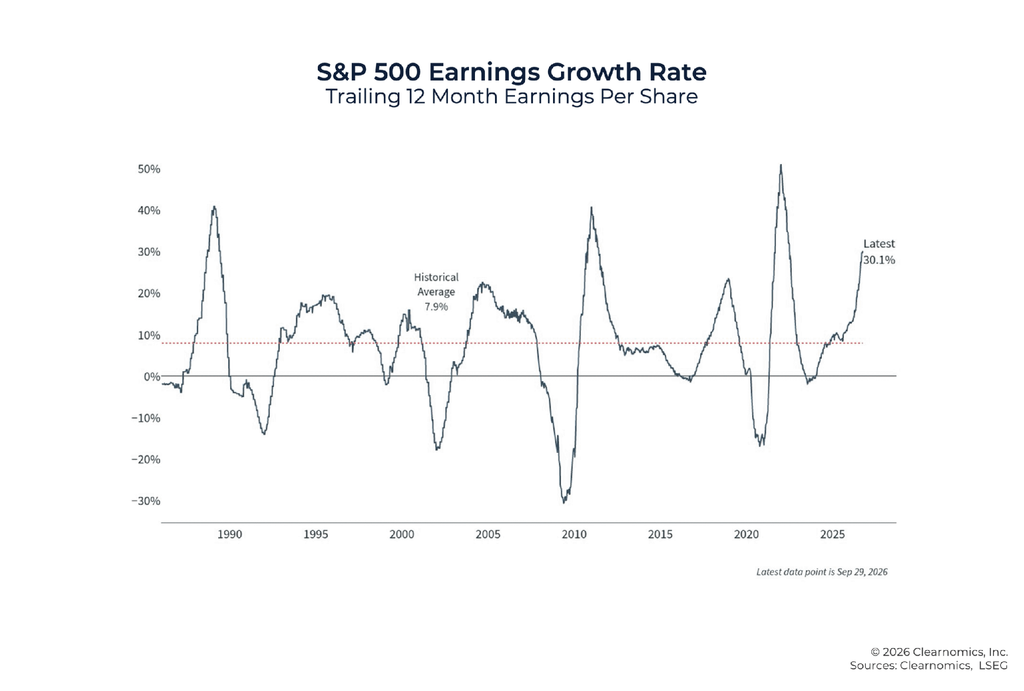
You could argue that stock valuations are “correcting” while stock prices are up and now stable in 2026. Valuation metrics contracting a bit in the face of higher interest rates seems logical and a healthy sign, but corporate earnings have been so strong that values have not been hurt.
I won’t try to forecast whether rising rates (or other economic factors) will slow economic activity and corporate profits, but it is a possibility. Or this resilient market might shrug it off and continue to benefit from strong earnings.
The urge to “have a view” or “make a prediction” is alluring, but I will resist. You should resist, too. What you should do is have a portfolio that is built to succeed over the long haul in many types of markets, because over the long term…you will see many types of markets. Including one where stocks are strong despite rising interest rates and inflation is above the Fed’s 2% target!
A New Investment Idea: UPREITS and deferred capital gain on property “sale”
When I began my wealth management practice, I knew clients would have capital gains taxes from appreciated stocks, but I underestimated the need to manage capital gains taxes from selling real estate.
The tax bill for selling an investment property can be surprisingly large. California treats all capital gains as ordinary income (13.3% top marginal bracket).
Example:
Purchase Price: $500,000
Current property value – $2,500,000
Tax rate = 37.1% (federal capital gain rate + CA ordinary income + Net Investment Income Tax)
(note: if you have depreciated your property to take advantage of the tax deferral, you will have depreciation “recapture” upon sale, requiring you to pay capital gain tax on that amount
Estimated Capital Gain Tax (including depreciation recapture) = ~$750,000!!
UPREITS – like a 1031 exchange into a Real Estate Investment Trust
I have previously discussed in my newsletter the power of Long-Short Direct Indexing to generate losses that will reduce your net gain on assets sold, but there is another interesting option for property – an UPREIT.
In an UPREIT, you can “transfer” your investment property to a diversified investment trust of income-producing properties and retain an income stream commensurate with your property’s cashflow characteristics. Section 721 of the IRA code generally allows the contribution without recognizing the built-in gain immediately.
Benefits
- Instant diversification
- No tax liability upon transfer of assets into the UPREIT
- Withdraw your tax basis ($500K in the example) with no taxes due
- No property management headaches
- Pay taxes only as you sell your units in the REIT
Considerations and Risks
- Cannot roll this investment into another property using a 1031 exchange
- An UPREIT provides partnership units, not shares in a publicly traded REIT (K-1 tax treatment)
- Two- to three-year average holding period until you can begin selling units in the REIT – Liquidity Risk
This strategy can be very helpful for clients with the following profile:
- No longer willing or capable of managing/administering to a rental property
- Don’t want the risk of owning individual investment properties
- No need for a big cash influx upon sale
- Want a steady income stream from the property that exceeds the passive rental income (cashflow + sale of Operating Units of the REIT)
An important Note: it is possible to move your primary residence into an UPREIT, but it must first qualify as an investment property to do so. To convert a primary residence to an investment property, the IRS rules are relatively straightforward and flexible:
- You must rent out the house at fair market value for 2 years before the contribution
- The house is required to be rented at fair market value, but must only be rented for 2 weeks each year to qualify
Case Study: Unlocking the Value of your Corporate Benefits
My experience is that most employees understand the value of their 401K and health insurance benefits. What many of them don’t understand, especially if they are executives of large companies like the ones we have in Silicon Valley (Apple, Nvidia, Google, etc.), is the value of their other benefits.
This case study is with an Apple executive but could have easily been with someone from one of the many large firms in the Valley.
Big Tax and Diversification Benefits from your Employer
I am expecting to save an Apple executive ~$200,000 on his 2026 tax bill, provide him with a more diversified portfolio, and help him invest extra money in a tax-free vehicle by using his other company benefits! Here’s what we did:
- Deferred Compensation Plan: Deferred $400,000 of 2026 income and moved that money into a diversified investment portfolio that he will be able to withdraw and pay his deferred taxes only when he leaves the company – all at once or slowly over as much as 10 years. He is currently living off the sale of his company stock (RSUs), which he must pay tax on when they vest.
- Convert his 401K to a BrokerageLink account – this allows him to invest in virtually any investment available at Fidelity, rather than just those investments offered through the 401K (other 401K administrators offer similar options).
- Open a Mega Backdoor Roth IRA – Apple and many other companies provide their employees with the option of investing as much as $72,000 a year in retirement accounts (more if you are 50+). Subtract your and your employer’s contributions to your 401K from $72,000. The balance can be placed in a Roth IRA that allows you to compound and distribute money at retirement age tax-free!
Many companies don’t advertise these benefits, for fear they will create liability for themselves by “providing advice”. Check your benefits page and ask your benefits manager about what is available at your company!
Question from the Audience: Why has the value of my bond funds gone down this quarter?
You might have noticed in my “Markets and Commodities” table at the beginning of the newsletter that the only asset class ETF that is down for the year is bonds.
Why do bond values go down and what is really happening? This is often misunderstood. Bonds are loans – a promise to pay your principal back plus an interest rate (yield) for loaning your money to a government, corporation, or other entity.
When interest rates go up, the same entities now must pay more interest to you (the “lender”) to borrow the money. That means existing bonds are worth less, because they are paying less interest. That is what causes the bond ETF values to go down (or up, if interest rates are dropping). It doesn’t change the interest you are paid by the bonds, and future bond purchases, all other things being equal, will be at higher interest rates.
The value of your existing bond fund is only important if you are going to sell, and bond funds, when used correctly, are not typically purchased for short-term or medium-term time horizons.
Keep in mind that even though interest rates have risen off the rock bottom rates of 6 years ago, they are now close to their long-term average. What this means is that there is an equal long-term probability that future bond values will go up or down.
Remember the true value and role of bonds –
- To provide consistent growth above the rate of inflation, growing your portfolio at a volatility far below stocks – this becomes more important as you come closer to retirement age, when you have less time to recover from a major drawdown in the equity markets (eg. 2000-2002 and 2008-2010)
- To provide income if needed for retirement or unexpected interruptions in your earning power without forcing the sale of stocks during a down cycle (down cycles can last from a few years to as long as a decade)
Summary
There are very different but important messages in this quarter’s newsletter, but I would summarize them in this way:
- No one can accurately forecast economic outcomes, or variables such as interest rates or stock market returns in the short or medium term, so don’t try to do it. Create an all-weather portfolio and take advantage of long-term anomalies and market dislocations when they arise.
- If you have a valuable, income-producing piece of property, know all the options available to you if you are considering selling. UPREITS are an interesting option for some property owners to maximize their after-tax returns.
- Don’t assume you understand, or even know about, all the tools and benefits available through your employer – often, companies do not “advertise” all features and tools available to you
- Bond math is not intuitive and can be difficult to understand. The income that bond ETFs provide doesn’t change when interest rates move. Know why you own bonds and don’t spook if the prices go down.
Enjoy the Holidays and look for my next Newsletter early in 2027!
Remember, I am available to answer your questions whenever they arise – just ping me!
Sincerely,
Mike…
Reader Survey: What Should I Cover Next?
Email mike@prosperowealth.com and let me know what topics matter most:
Markets • Investing • Taxes • Retirement • Concentrated Stock • Planning
— Mike
Advisory services are offered through Prospero Wealth, LLC, an investment adviser registered with the Securities and Exchange Commission. Advisory services are only offered to clients or prospective clients where Prospero Wealth, LLC and its representatives are properly registered or exempt from registration.
This material is for informational purposes only and should not be construed as investment, tax, or legal advice. Past performance is not indicative of future results. All investments involve risk, including loss of principal. Index performance is shown for illustrative purposes only and is not directly investable. Data sources include publicly available information believed to be reliable but not guaranteed. Any holdings identified do not represent all of the securities purchased, sold, or recommended for advisory clients of Prospero Wealth, LLC.”